
A drive away price is the full figure you hand over to put the car on the road: the vehicle itself, dealer delivery, registration, CTP insurance, stamp duty and plates. It exists so you can compare one quote with another without doing tax arithmetic in a showroom. The catch is that the words drive away only protect you when they are in writing on the quote, and when you know what sits inside the number.
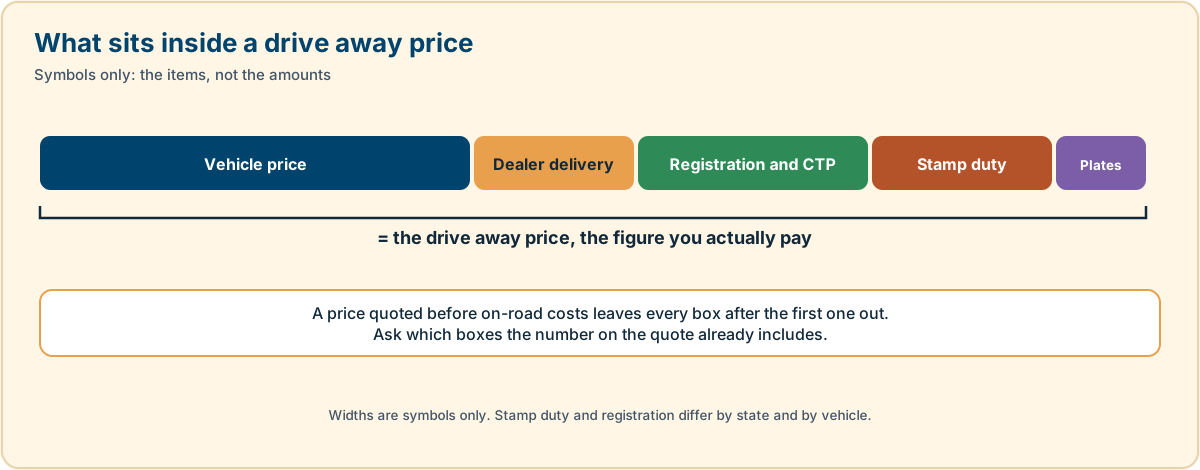
What drive away actually covers
Think of the price as a stack of boxes. The vehicle price is the biggest box, and the rest are government and dealer charges that have to be paid before the car is legally yours to drive.
- Vehicle price. The car in the exact variant, colour and options you chose. This is the only box the dealer fully controls.
- Dealer delivery. A dealer charge for preparing the car. It varies between dealers, which makes it a fair place to ask questions.
- Registration and CTP. State charges for the first period of registration and compulsory third party insurance.
- Stamp duty. A state tax on the purchase. Because it is set by each state, the same car lands at a different drive away figure across borders.
- Plates. A small charge, but part of the stack.
Everything in that stack belongs in a drive away quote. If a quote is before on-road costs, it is missing most of the boxes, and it will grow before you sign.
Drive away versus plus on-roads
Dealers advertise both ways, and a price before on-road costs always looks better than it is. The habit worth building is simple: never compare a drive away figure with a plus on-roads figure. Ask every dealer for the same thing, drive away, in writing, for the same variant and options. Once the quotes answer the same question, the cheapest one is actually the cheapest.
Where quotes grow between the handshake and the contract
A drive away quote stops the government charges surprising you. It does not stop the contract growing in other ways, so watch for these.
- Accessories added at signing. Floor mats, tinting, paint protection and roof racks are all extras. Decline anything you did not ask for, and price anything you do want on its own.
- A different variant. If the car in stock is one trim level up, the quote you compared is no longer the quote you are signing.
- Registration period. Ask how many months of registration the price includes.
- The trade-in folded in. Keep the trade-in as a separate written figure, or you cannot tell what the car itself cost you.
How to use this when you shop
Pick the variant first, then ask every dealer the same question: what is your drive away price for this exact car, in writing, and what does it include. Keep each answer. A notebook works, and the Car Verdict app was built for exactly this: capture each quote while you stand there, and the comparison builds itself instead of living in your head. If you are still choosing between brands, our car brands catalogue lists the current models side by side.
When you have two or three written drive away quotes for the same car, you are no longer guessing. See how to compare new car quotes from different dealers for the full method.
Questions people ask
What does drive away price mean?
It is the full figure you pay to put the car on the road: the vehicle, dealer delivery, registration, CTP, stamp duty and plates. Nothing you did not agree to should be added after it.
Is drive away cheaper than paying on-road costs separately?
Not automatically. It is the same set of costs stated up front. Its value is that two drive away quotes for the same variant can be compared directly.
Why do drive away prices differ between states?
Stamp duty, registration and CTP are state charges, so the same car lands at a different drive away figure in each state. Compare quotes within your own state.
Can a dealer add costs after quoting drive away?
Get the quote in writing with the words drive away on it. Extras you agree to later, such as paint protection or accessories, can still be added, so decline anything you did not ask for.
The Car Verdict team